Research
Peer-reviewed work, spatial analysis, and field research on how cities are lived in — from the sociology of homelessness to Traces of Life, an in-progress EEG and behavioural study of how old and new public housing feels in Hong Kong.
Flagship — Traces of Life
Master of Urban Design, HKU · in progressAn EEG and behavioural study of affective response to old versus new public housing in Hong Kong.
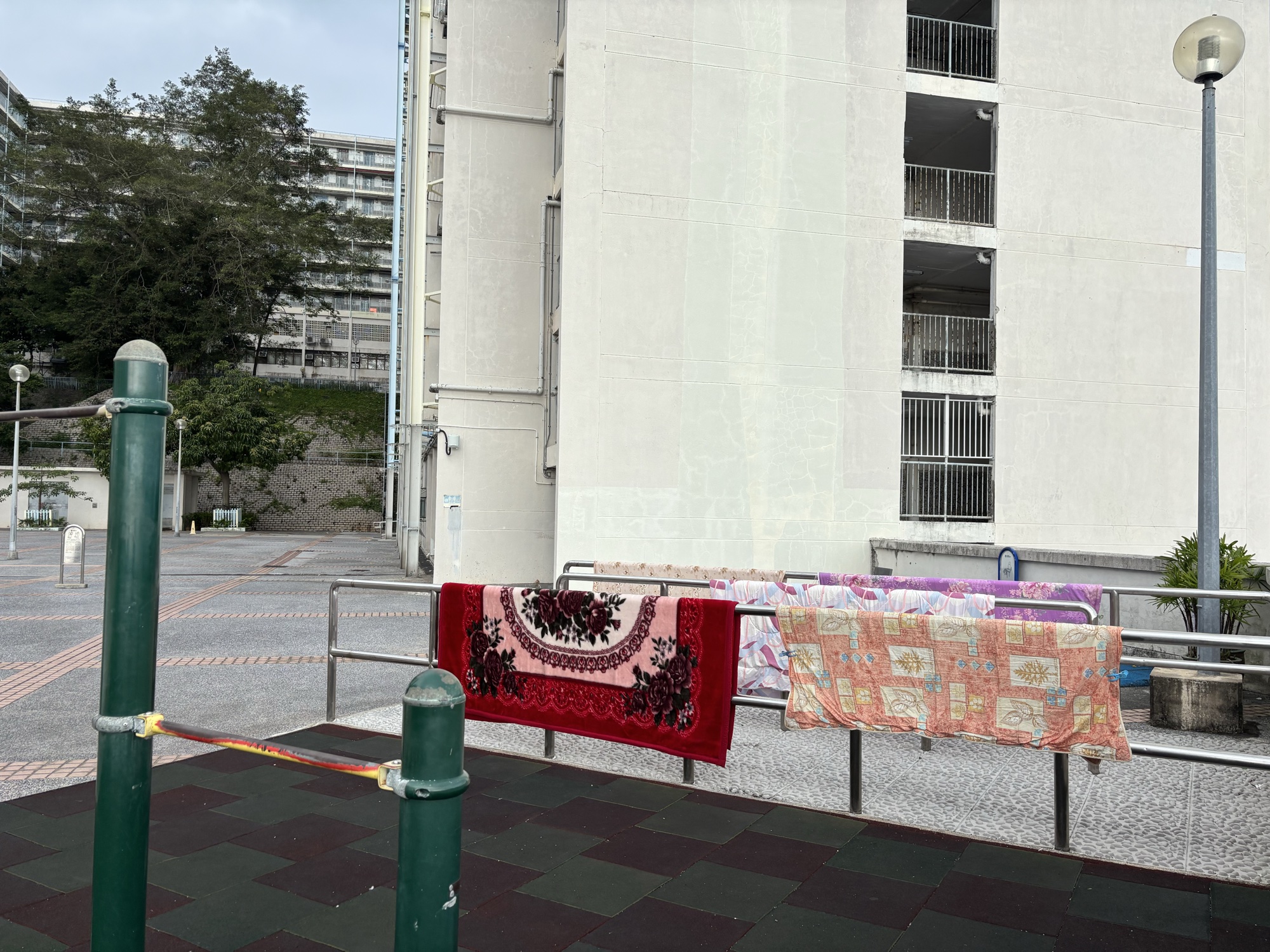
Master's research in progress, The University of Hong Kong (Urban Design), supervised by Dr Alice Vialard with Dr Waishan Qiu and Dr Bin Jiang. It started from a simple observation: an old housing estate, soon to be demolished, felt more alive than the polished new towers built to replace it — because of the visible traces of inhabitation residents leave behind. The study introduces Inhabited Visual Complexity (IVC): the visual richness that accumulates through decades of living — laundry, plants, grilles, signage, small personal things — and asks whether it is part of what makes older estates feel welcoming rather than threatening. The planned design pairs EEG (frontal alpha asymmetry, frontal alpha and beta; Emotiv EPOC X) with self-report (SAM, PRS-11) and an online perception survey pre-registered on OSF and run with Prolific, comparing two old estates and two new developments across six shared-space typologies. The main comparison uses real, controlled photographs normalised in CIELAB for luminance and colour so that era, rather than image exposure or palette, drives the comparison, with an IVC gradient generated by inpainting kept as a separate, clearly labelled condition. Semantic segmentation yields roughly forty morphological measures — inhabited-element density, visual entropy, green view index, enclosure — that feed linear mixed-effects models with estate as a random effect. So far only a small behavioural pilot has data; the behavioural strand is under way and the EEG strand is still to come.
Spatial analysis
Two analytical studies that read urban form from data — where heat risk is structured by built form in Hong Kong, and how the legibility of informal Manila has shifted over two decades.
Urban Heat Island, Hong Kong
Health impact assessment · 2024A health-impact assessment built end-to-end from satellite remote sensing.
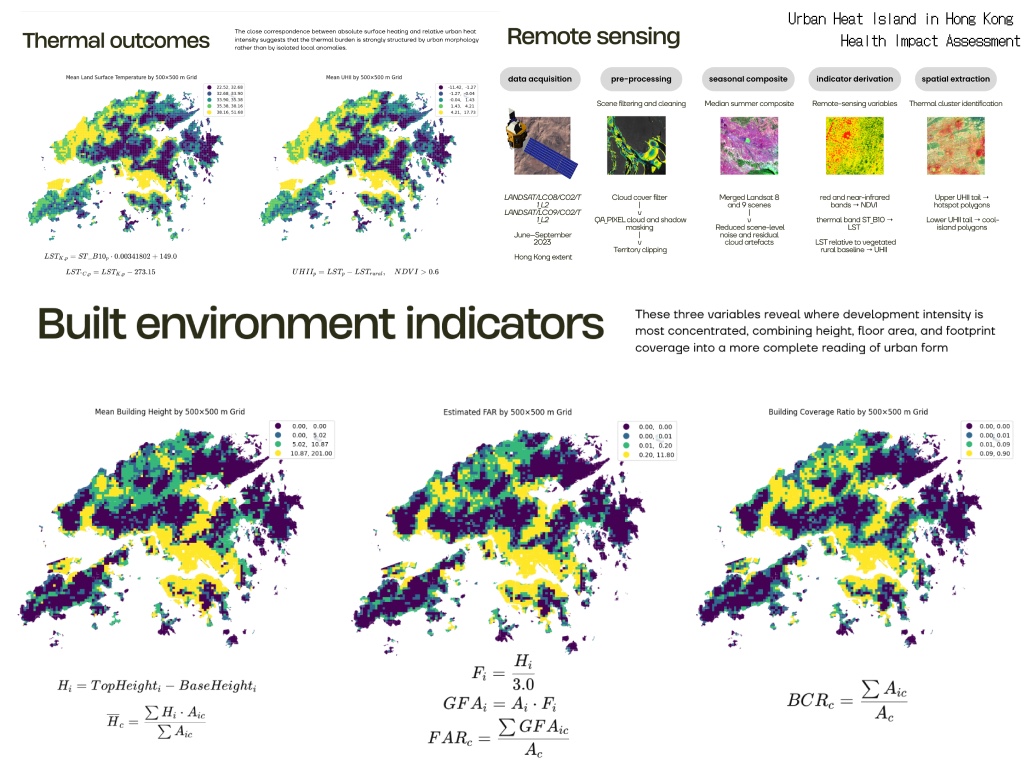
A health-impact assessment of Hong Kong's urban heat island, built end-to-end from satellite remote sensing. Using summer Landsat 8/9 imagery (C02/T1 L2, Jun–Sep 2023), the analysis derives land-surface temperature and Urban Heat Island Intensity on a 500×500 m grid, then links the thermal burden to built-environment indicators — mean building height, floor-area ratio, and building coverage — showing where heat risk is structured by urban form rather than isolated hotspots.
Space Syntax, Manila
Spatial analysis · 2025Informal settlements across 2004, 2014, and 2025.
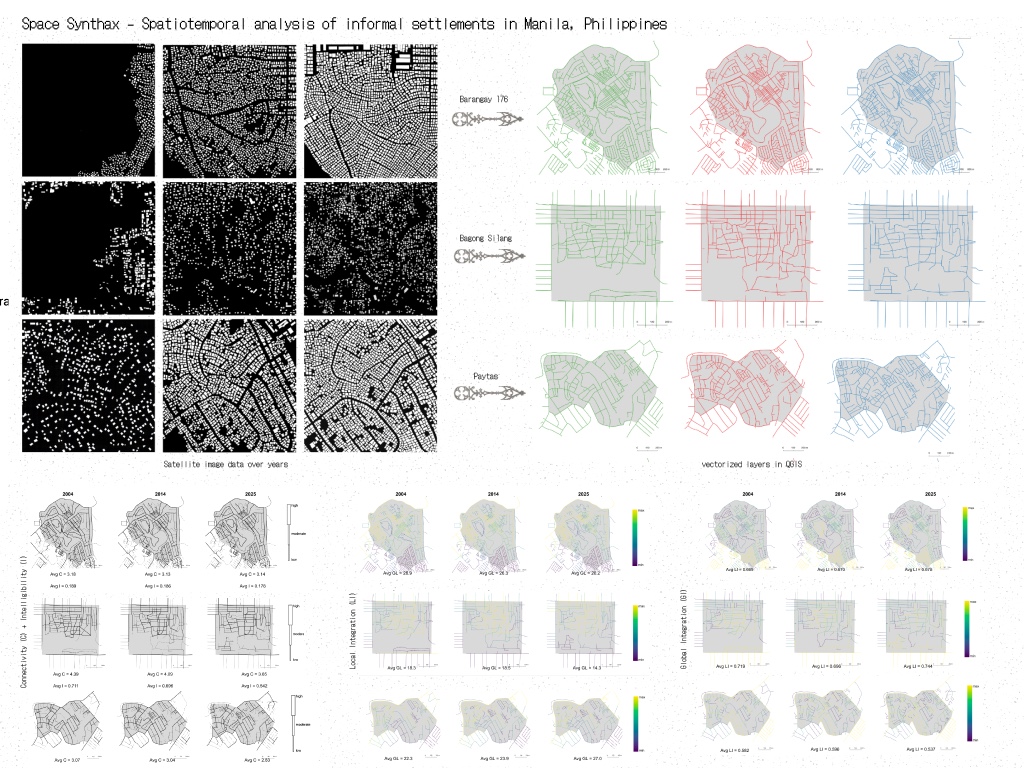
A spatiotemporal space-syntax study of three of Manila's informal settlements — Barangay 176, Bagong Silang, and Payatas — across 2004, 2014, and 2025. Satellite imagery is vectorized in QGIS and analysed for connectivity, intelligibility, and local and global integration, tracing how the structure and legibility of informal urban fabric shift over two decades.
Research themes
-
Homelessness & the city ("home")
Sole-authored, peer-reviewed study of how people experiencing homelessness inhabit Moscow; talks at the Hong Kong Sociological Association (2024) and the Vysokovsky Forum (2023). The domain through-line.
-
Ethnicity & social structure (Dagestan)
Co-authored, peer-reviewed work on the rules regulating ethnic-category membership; how humour encodes social structure.
-
Urban environment & wellbeing (Krasnodar)
How environmental quality relates to citizens' wellbeing (conference paper, 2023).
-
Transport systems
Drivers of tram and trolleybus development in Russian cities (conference paper, 2023).
-
Night street-view imagery (HKU)
Ongoing data work on night-time street-view images.
Research expeditions
Ethnographic fieldwork · 2021–2023Nine sociological / ethnographic field expeditions across Russia — in-depth and expert interviews, focus groups, surveys, mapping, transcript analysis, visual documentation.
Summer schools & continuing education
-
Urbanist Summer School (HSE × SPbU × ITMO)
St Petersburg, 2023. Tourist-flow forecasting; territory product & marketing.
-
Moscow, 2023. GIS for urban analytics; digital monitoring of green infrastructure; digital ethnography.
-
Re-school (RDNK Architects)
Moscow, 2024. Historical-territory analysis; valuation & development potential of heritage sites.
Publications
Peer-reviewed · ORCID 0009-0008-7900-9839-
Varshaver, E. A., Khabibullin, A. M., Samosudova, A. D., & Shults, A.-V. E. (2024). "By the father" or "by both parents"? Variations of the descent classificatory rule regulating membership in ethnic categories in contemporary Dagestan. Monitoring of Public Opinion: Economic and Social Changes, (1), 176–201. (In Russ.) DOI · ResearchGate
-
Shults, A. V. (2024). In the Shadow of the Metropolis: Ways of Using Urban Space by Homeless People (Moscow). The Ways of Russia (Пути России), 2(4), 15–41. (In Russ.) jrsre.ru
-
Shults, A. V. (2024). Review of Lenhard, J., Making Better Lives: Hope, Freedom, and Home-Making among People Sleeping Rough in Paris (Oxford/New York, 2022). The Ways of Russia, 2(4), 267–270. [book review] (In Russ.) jrsre.ru
-
Drozdova, A. (now Shults), & Malinovsky, A. (2022). Panoramic window with a mountain view: how "ethnic" jokes help to understand the social structure of Dagestan. In In the Footsteps of Ethnic Diversity in Modern Dagestan. HSE Publishing House. (In Russ.) ResearchGate
Selected conference papers
-
Alliance of Social Sciences — 5th International Conference of Young Scientists, Moscow
"Panoramic window with mountain views: how 'ethnic' jokes help understand the social structure of Dagestan"
-
XXIII Yasin (April) International Academic Conference, HSE, Moscow
"Panoramic window…"; "The health of Krasnodar: how the urban environment affects citizens' wellbeing"
-
A. A. Vysokovsky Forum, Moscow
"The role of NGOs in helping the homeless in the Urals"
-
SNK-2023, Moscow Polytechnic University
"Factors influencing the development of tram and trolleybus systems in Russian cities"
-
"Iran's Foreign Policy" International Student Conference, Moscow
"The evolution of post-Soviet Iranian–Russian cultural ties"
-
Hong Kong Sociological Association, 25th Annual Conference, Hong Kong
"'Everyone on the porch': the spatial aspect of homelessness in Moscow"
Let's build something for cities.
Open to collaborations, talks, and publications — based in Hong Kong.